
Best AC Stabilizer in India (2026)Top Picks for Inverter & Non-Inverter ACs
Protect your air conditioner from voltage fluctuations with a reliable stabilizer. We tested 12 popular models across Indian homes to find the best voltage stabilizers for 1 ton, 1.5 ton, and 2 ton ACs.

Reviewed by Sulaiman Sekh
HVAC Technician · 8+ Years Experience · Field Tested
Quick Answer
The best AC stabilizer in India for most 1.5 ton units is the V-Guard VG 400 (170V–270V, 4 kVA, 3-year onsite warranty with V-Guard's Intelligent Time Delay System). For low-voltage areas, the Everest EWD 400-N double-booster (150V–270V) or V-Guard iD4 Ace 5540 (130V–280V) handle deeper dips. Modern inverter ACs from LG, Panasonic, and Daikin often don't need a stabilizer as they handle 120V–290V natively. A stabilizer is insurance against voltage damage, not an electricity saver.
Stabilizer is insurance, not efficiency
A stabilizer does not reduce your electricity bill — it consumes only 2–3W. Its value is preventing ₹8,000–₹15,000 PCB or compressor repairs from voltage
Modern inverter ACs often don't need one
LG, Panasonic, and Daikin inverter ACs handle 120V–290V natively. Only add a stabilizer if your area has frequent drops below 120V or spikes above 290V.
V-Guard VG 400 is best for 1.5 ton
Covers 170V–270V with V-Guard's Intelligent Time Delay System and a 3-year onsite warranty. A solid budget alternative is the Microtek Pearl EM4160+ V2 (160V–285V).
One stabilizer per AC is recommended
Even if a single large stabilizer can handle combined load, individual units are easier to diagnose, replace, and protect each AC independently.
Relay stabilizers are best for homes
Faster, lighter, cheaper, and maintenance-free compared to servo stabilizers. Servo units at ₹8,000+ are overkill for most residential AC protection needs.
Top 5 AC Stabilizers in India (2026)
All 4 kVA rated — the correct size for a 1.5 ton AC and the most common home requirement — ranked by working range, protection features, build quality, and warranty across Indian grid conditions.

V-Guard VG 400
Working Range
170V – 270V
Capacity
4 kVA (4,000W)
Warranty
3-year onsite
Pros
- Proven copper-wound build
- Intelligent Time Delay System (ITDS)
- Widest V-Guard service network
- 3-year onsite warranty
Cons
- Range not suited to sub-160V dips

Microtek Pearl EM4160+ V2
Working Range
160V – 285V
Capacity
4 kVA (4,000W)
Warranty
3-year
Pros
- Excellent value for money
- Wide 160–285V working range
- Wall-mountable design
- Thousands of real owner ratings
Cons
- No support for sub-160V dips
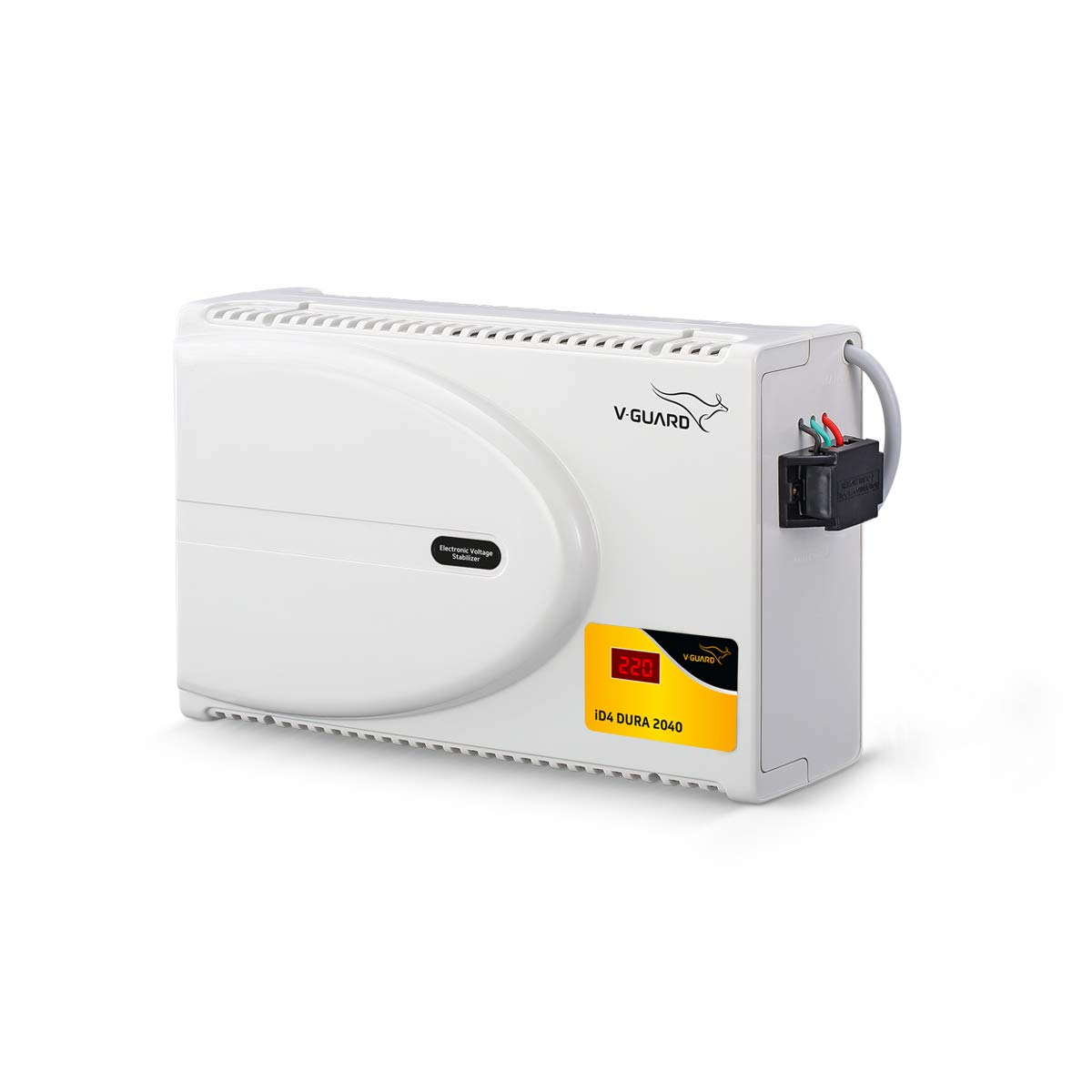
V-Guard iD4 Dura 2040
Working Range
160V – 280V
Capacity
4 kVA (4,000W)
Warranty
3-year
Pros
- Digital voltage display
- Intelligent Time Delay System (ITDS)
- Energy-efficient design
- Wider range than VG 400
Cons
- Priced slightly above the VG 400
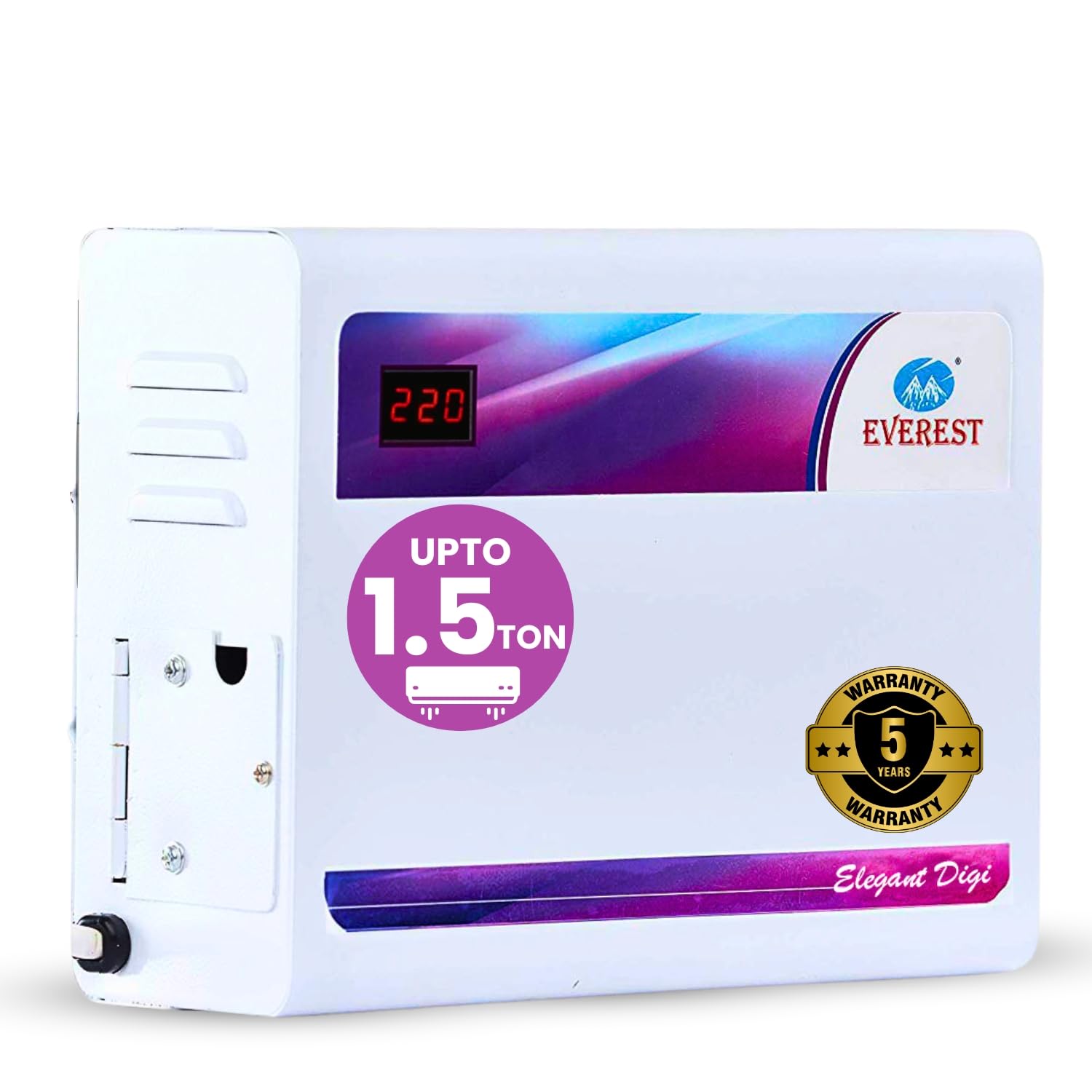
Everest EWD 400-N Double Booster
Working Range
150V – 270V
Capacity
4 kVA (4,000W)
Warranty
5-year
Pros
- Double-booster for low-voltage areas
- Digital voltage display
- Toroidal transformer
- 5-year warranty (longest here)
Cons
- Smaller service network than V-Guard

V-Guard iD4 Ace 5540
Working Range
130V – 280V
Capacity
4 kVA (4,000W)
Warranty
3-year
Pros
- Widest 130–280V working range
- EMI filter protection
- Colour-changing LED display
- Best for deep voltage dips
Cons
- Premium price
After calculating, explore the best ACs that match your results. top air conditioners →
If you are comparing different AC models and prices, exploring a complete guide can help you choose the right one. Best AC in India →
Quick Comparison Table
Side-by-side specs for all five picks — working range, capacity, and warranty at a glance.
| Model | Voltage Range | Capacity | Warranty | Best For |
|---|---|---|---|---|
| V-Guard VG 400 | 170V – 270V | 4 kVA | 3-year onsite | Best overall for most homes |
| Microtek Pearl EM4160+ V2 | 160V – 285V | 4 kVA | 3-year | Best budget pick |
| V-Guard iD4 Dura 2040 | 160V – 280V | 4 kVA | 3-year | Wider range + digital display |
| Everest EWD 400-N Double Booster | 150V – 270V | 4 kVA | 5-year | Low-voltage areas, longest warranty |
| V-Guard iD4 Ace 5540 | 130V – 280V | 4 kVA | 3-year | Severe voltage fluctuations |
Need help choosing the right stabilizer for your AC? Read our detailed V-Guard Stabilizer Review with a full compatibility guide and voltage protection breakdown.
How to Choose the Right AC Stabilizer
Six essential factors that separate real protection from marketing claims.
Match Capacity to Your AC
A 1.5 ton inverter AC draws up to 1,650W at peak. Your stabilizer must handle at least 2,000W continuously with headroom for startup surge. Undersized stabilizers overheat and provide false protection.
Check the Voltage Range
If your area sees drops below 140V or spikes above 270V, you need a stabilizer with at least 90V–300V range. Budget models often cap at 150V–280V, which leaves you exposed during severe dips.
Zero Switchover Delay is Critical
The most dangerous moment is when voltage recovers after a dip. Cheap stabilizers take 200–500ms to switch back, leaving your AC unprotected. Always choose a model with zero-delay relay switching.
Look for Thermal Overload Protection
This feature safely shuts down the stabilizer if it overheats, preventing damage to both the stabilizer and your AC. Auto-reset after cooling is a bonus.
Wall-Mountable Saves Space
Outdoor unit areas in apartments are often cramped. A wall-mountable stabilizer keeps wiring tidy and prevents accidental water ingress from floor-level placement during monsoons.
Warranty & Service Network
A 3-year warranty is ideal. More importantly, check if the brand has service centers in your city. V-Guard leads here with the widest stabilizer service network in India.
Choosing the right AC depends on multiple factors, including budget and room size. best AC models →
Related Guides & Comparisons
Explore more resources to make the right AC buying decision.
V-Guard Stabilizer Review
Full in-depth review with voltage tests and real-world protection data.
Stabilizer for 1 Ton AC
Top picks for 1 ton inverter and non-inverter ACs with exact KVA sizing.
Stabilizer for 1.5 Ton AC
Best stabilizers for 1.5 ton split ACs including copper winding and 4 KVA picks.
Stabilizer for 2 Ton AC
4 KVA+ stabilizers and double/triple booster options for heavy loads.
Stabilizer Sizing Guide
Exact KVA formula and compatibility chart for every AC tonnage.
Double Booster Guide
When and why to buy double or triple booster stabilizers for low-voltage grids.
Best AC in India
Top 10 air conditioners ranked by efficiency, cooling, and durability.
Inverter vs Non-Inverter AC
Understand compressor technology and long-term electricity savings.
1 Ton vs 1.5 Ton AC
Choose the right AC size for your room with our tonnage guide.
Find the best AC models that fit your calculated needs. top air conditioners →
Explore the best AC models based on price, performance, and efficiency. Our ranked guide covers everything from budget picks to premium 5-star inverter options. Compare best ACs →
Explore the best AC models based on price, performance, and efficiency. best AC models →
Compare top-rated air conditioners ranked by real-world performance and energy efficiency. Best AC in India →
We may earn a commission when you purchase through links on this site, at no extra cost to you. This helps us keep our guides free and independently researched.
Frequently Asked Questions
Straight answers to common questions.
Is a stabilizer required for inverter AC?
It depends on your power supply. Modern inverter ACs from LG, Panasonic, and Daikin operate stabilizer-free from 120V–290V. If your grid stays within this range consistently, you may not need one. However, in areas with frequent fluctuations or rural/semi-urban locations, a stabilizer is still recommended insurance against costly PCB failures.
What happens if I run an AC without a stabilizer?
In stable urban areas, nothing. But in fluctuating areas, low voltage causes the inverter PCB to overheat and fail (replacement cost ₹8,000–₹15,000). High voltage burns compressor windings. Recovery surges after power cuts can instantly destroy the inverter module. A ₹4,000 stabilizer prevents all of this.
Which stabilizer is best for 1.5 ton AC?
The V-Guard VG 400 (4 kVA) is our top pick for 1.5 ton ACs — it covers 170V–270V with V-Guard's Intelligent Time Delay System (ITDS) and a 3-year onsite warranty. For budget buyers, the Microtek Pearl EM4160+ V2 (160V–285V) is a solid alternative, and for severe low-voltage areas the V-Guard iD4 Ace 5540 handles 130V–280V.
Does a stabilizer reduce electricity bill?
No. A stabilizer's job is protection, not efficiency. It consumes only 2–3W in standby — negligible in your monthly bill. What it does is prevent efficiency degradation by protecting your AC's inverter PCB and compressor, ensuring it runs at rated ISEER for its full lifespan.
Can I use one stabilizer for two ACs?
Only if the stabilizer's rated capacity exceeds the combined peak load. Two 1.5 ton ACs drawing 1,650W each would need at least a 4,000W stabilizer. However, we recommend individual stabilizers for each AC because voltage events affect units at different times, and individual units are easier to diagnose and replace.
What is the difference between relay and servo stabilizer?
Servo stabilizers use a motor-driven variable transformer for precise ±1% voltage correction. They're slower, heavier, and more expensive (₹8,000+). Relay stabilizers use electronic relays to switch between transformer taps — faster, lighter, cheaper, and maintenance-free. For home AC protection, relay stabilizers like the V-Guard VG 400 are the practical choice.
Expert Review by Sulaiman Sekh
HVAC Technician · 8+ Years Experience · Fact-checked & field-tested
Related guides
Stabilizer for 1 Ton AC
Top picks for 1 ton inverter and non-inverter ACs
Stabilizer for 1.5 Ton AC
Best stabilizers for 1.5 ton split ACs including copper and 4 KVA picks
Stabilizer for 2 Ton AC
4 KVA+ stabilizers and double/triple booster options for 2 ton ACs
Stabilizer Sizing Guide
How to calculate KVA needed for any AC tonnage with formula and chart
Double Booster Guide
When and why to buy double or triple booster stabilizers for low-voltage grids
V-Guard Stabilizer Review
In-depth review of V-Guard i4 with voltage tests and compatibility guide
