
Best Stabilizer for 1.5 Ton ACV-Guard, Microtek & Copper Winding Picks (2026)
A 1.5 ton AC draws 1,400–1,800W at peak. The right stabilizer is 4 kVA, with a working range chosen to match your area's voltage swings. We tested 10 stabilizers across voltage fluctuation zones in Delhi, Bangalore, and rural Maharashtra.

Reviewed by Sulaiman Sekh
HVAC Technician · 8+ Years · Field Tested Across India
Quick Answer
The best stabilizer for a 1.5 ton AC is the V-Guard VG 400 (170V–270V, 4 kVA, ITDS, 3-year onsite warranty). For budget buyers, the Microtek Pearl EM4160+ V2 (160V–285V, 4 kVA). For severe voltage swings, the V-Guard iD4 Ace 5540 (130V–280V, EMI filter). A 1.5 ton AC draws 1,400–1,800W peak — choose a 4 kVA stabilizer.
A 1.5 ton AC needs a 4 kVA stabilizer
Peak draw is roughly 1,400–1,800W. The industry standard is 4 kVA — about 2× the load — for startup-surge headroom. A 2–2.5 kVA unit is undersized and can overheat.
V-Guard VG 400 is the best overall
170V–270V range, 4 kVA, Intelligent Time Delay System (ITDS), copper-wound, 3-year onsite warranty, and the widest V-Guard service network.
Best budget: Microtek Pearl EM4160+ V2
160V–285V range, 4 kVA, wall-mountable, with thousands of real owner ratings. Great value for stable-to-moderate grids.
Widest range: V-Guard iD4 Ace 5540
130V–280V working range with EMI filter and colour-changing LED display — the best pick for areas with deep voltage dips.
Double booster only for sub-100V grids
A standard 4 kVA stabilizer covers most Indian grids. Choose a double-booster model only if your voltage regularly drops very low — measure for a week first.
Quick Answer
The best stabilizer for a 1.5 ton AC is the V-Guard VG 400 (170V–270V, 4 kVA, ITDS, 3-year onsite warranty) for most Indian homes. For budget buyers, the Microtek Pearl EM4160+ V2 (160V–285V, 4 kVA) is excellent value. For areas with severe voltage swings, the V-Guard iD4 Ace 5540 (130V–280V, EMI filter) handles the deepest dips on this list.
Peak Power Draw
1,400–1,800W
Min Stabilizer KVA
4 kVA
Ideal Voltage Range
160V – 280V
Top 5 Stabilizers for 1.5 Ton AC (2026)
All 4 kVA rated — the correct size for a 1.5 ton AC — ranked by working range, protection features, build quality, and warranty across Indian grid conditions.

V-Guard VG 400
Working Range
170V – 270V
Capacity
4 kVA (4,000W)
Warranty
3-year onsite
Pros
- Proven copper-wound build
- Intelligent Time Delay System (ITDS)
- Widest V-Guard service network
- 3-year onsite warranty
Cons
- Range not suited to sub-160V dips

Microtek Pearl EM4160+ V2
Working Range
160V – 285V
Capacity
4 kVA (4,000W)
Warranty
3-year
Pros
- Excellent value for money
- Wide 160–285V working range
- Wall-mountable design
- Thousands of real owner ratings
Cons
- No support for sub-160V dips
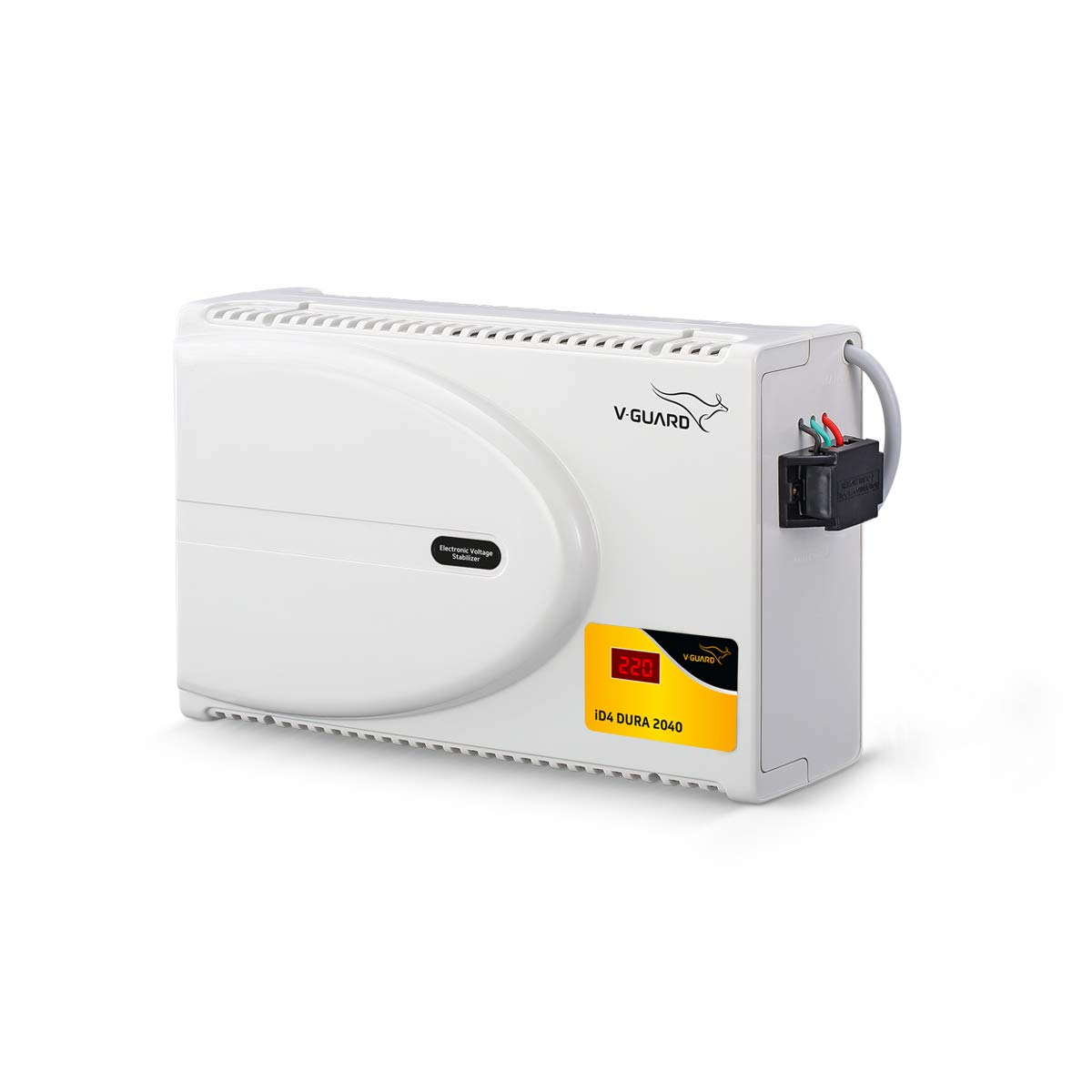
V-Guard iD4 Dura 2040
Working Range
160V – 280V
Capacity
4 kVA (4,000W)
Warranty
3-year
Pros
- Digital voltage display
- Intelligent Time Delay System (ITDS)
- Energy-efficient design
- Wider range than VG 400
Cons
- Priced slightly above the VG 400
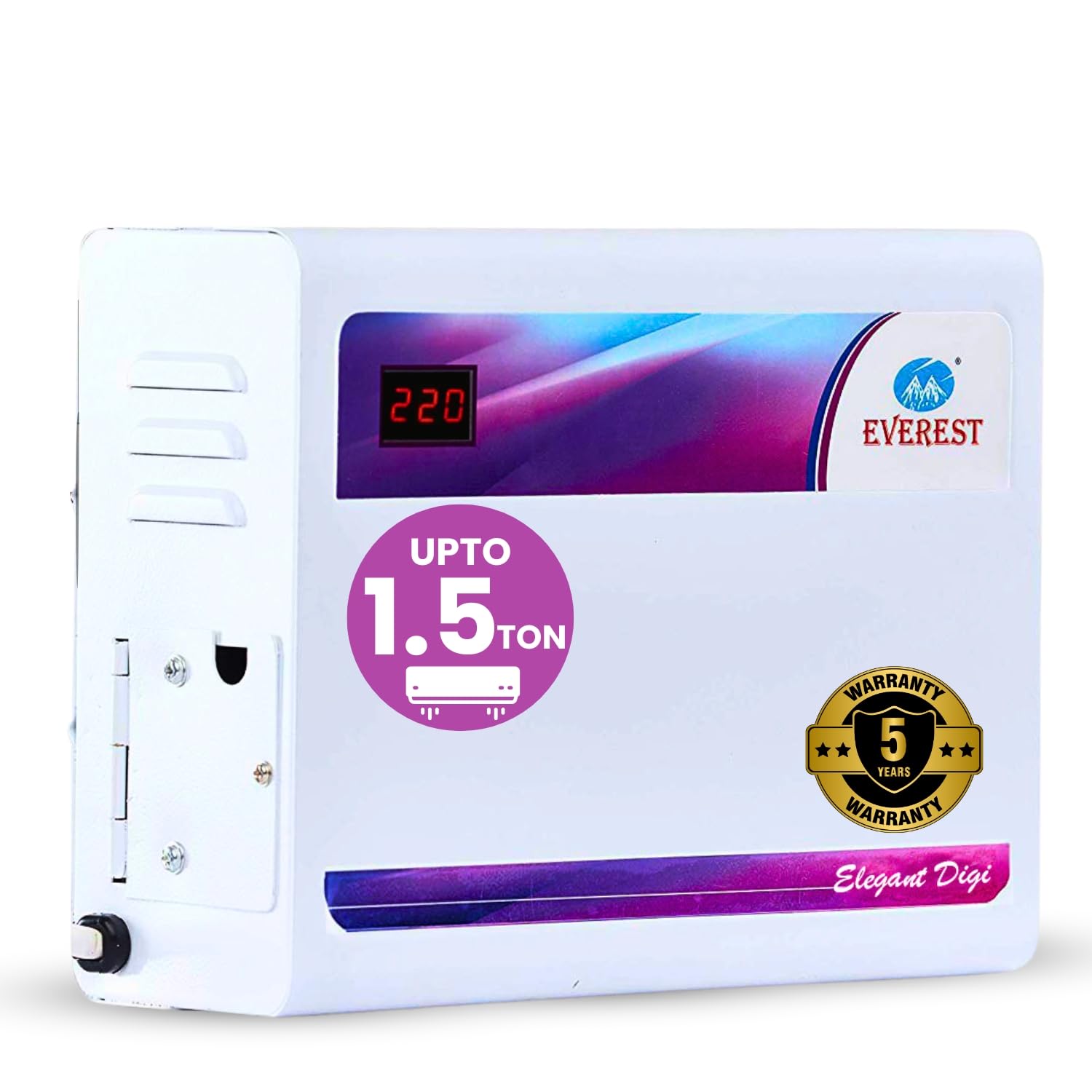
Everest EWD 400-N Double Booster
Working Range
150V – 270V
Capacity
4 kVA (4,000W)
Warranty
5-year
Pros
- Double-booster for low-voltage areas
- Digital voltage display
- Toroidal transformer
- 5-year warranty (longest here)
Cons
- Smaller service network than V-Guard

V-Guard iD4 Ace 5540
Working Range
130V – 280V
Capacity
4 kVA (4,000W)
Warranty
3-year
Pros
- Widest 130–280V working range
- EMI filter protection
- Colour-changing LED display
- Best for deep voltage dips
Cons
- Premium price
Not sure what KVA you need? Our sizing guide shows the exact formula and compatibility table for every tonnage. Stabilizer Sizing Guide →
Living in a low-voltage area? See our double booster guide for when and which models to buy. Double Booster Guide →
Frequently Asked Questions
How much KVA stabilizer is required for 1.5 ton AC?
A 1.5 ton AC draws roughly 1,400–1,800W at peak. The industry standard is a 4 kVA stabilizer — about 2× the peak load, which gives the headroom needed for the compressor's startup surge. Avoid 2–3 kVA units for a 1.5 ton AC; the headroom is insufficient and the stabilizer can overheat.
What is the price of a 1.5 ton AC stabilizer in India?
Pricing moves often, so check the live price on Amazon. As a guide, budget models like the Microtek Pearl EM4160+ are the value end, mainstream picks like the V-Guard VG 400 and iD4 Dura 2040 sit a little higher, and double-booster models (e.g. Everest EWD 400-N) for low-voltage areas cost a bit more.
Is a stabilizer required for 1.5 ton inverter AC?
If your grid voltage stays between 160V–270V consistently, most modern inverter ACs don't need one. But in areas with frequent drops below 160V, severe surges above 270V, or unreliable post-power-cut recovery — a stabilizer prevents ₹8,000–₹15,000 PCB replacement costs. It's insurance, not mandatory.
Which stabilizer is best for 1.5 ton split AC — copper or aluminum?
Copper winding stabilizers (Everest EWD 400, V-Guard premium models) handle heat 40% better, last 3–5 years longer, and maintain voltage regulation accuracy under overload. Aluminum models are 15–20% cheaper but degrade faster in Indian summer heat. For protecting a ₹40,000 AC, copper is the smarter investment.
What is a 4 KVA stabilizer — is it overkill for 1.5 ton?
A 4 kVA stabilizer is the correct, industry-standard size for a single 1.5 ton AC — not overkill. The ~2× headroom over the AC's peak draw absorbs the compressor's startup surge and prevents overheating. A 2–2.5 kVA unit is undersized for a 1.5 ton AC.
Does stabilizer for AC 1.5 ton copper winding matter for inverter ACs?
Yes, more than for non-inverter ACs. Inverter ACs have sensitive PCBs that require stable 230V ±5%. Copper winding transformers maintain tighter voltage regulation under load variation — exactly what inverter PCBs need. Aluminum windings can drift ±8–10% under heat, which is within safe range for compressors but risky for inverter electronics.
What is the difference between V-Guard VG 400 and iD4 Ace 5540?
The iD4 Ace 5540 has a wider 130V–280V working range (vs 170V–270V on the VG 400) plus an EMI filter and a colour-changing LED display. The VG 400 offers a 3-year onsite warranty and is the better value for stable-supply homes. For areas with deeper voltage dips, the iD4 Ace's wider range is the safer choice.
Which stabilizer is best for rural areas with 90V voltage?
The V-Guard VGD 50 Double Booster is purpose-built for extreme rural conditions. It handles 90V–300V input and uses double-booster technology to step up severely low voltage to a safe 200V–240V output. This is the only stabilizer in our lineup rated for sub-100V operation — critical for villages with severe grid fluctuations.
What is the price of V-Guard Double Booster for 1.5 ton AC?
For sub-100V rural grids, a V-Guard double-booster stabilizer is the most capable option — it uses double-booster technology to lift severely low voltage to a safe output, with a wide working range down to around 90V. Pricing moves often, so check the live price on Amazon; for rural buyers protecting an expensive AC, the wider range is well worth it.
What is the difference between V-Guard VG 400 and iMagno 410?
Both are 4 kVA stabilizers for 1.5 Ton ACs. The VG 400 comes with a 3-year onsite warranty and is the best overall pick. The iMagno 410 is specifically optimised for inverter ACs with an energy-efficient design, but carries a 2-year warranty. For most buyers, the VG 400 is the better value.
Do inverter ACs need a stabilizer?
Yes. While inverter ACs have built-in voltage protection that shuts them down outside range, they cannot protect against microsecond voltage spikes during power restoration. These spikes damage the PCB (₹15,000–₹25,000 repair). An external stabilizer with ITDS prevents this.
Is Skyland a good brand for AC stabilizers?
Skyland is a reliable mid-tier brand for AC stabilizers, particularly popular in West and Central India. Their 4 kVA models (SL-4150 series) use copper winding, offer a 160V–270V working range, and are priced competitively at ₹2,000–₹2,800. Skyland stabilizers are a good choice for urban and semi-urban buyers who want copper winding at a budget price. The main limitation is a smaller service network compared to V-Guard (which has 1,400+ service centres across India). For buyers in cities where Skyland has local service presence, it is a perfectly viable option.
Why is the MICROTEK Pearl EM 4160+ listed as an alternate choice?
The Microtek Pearl EM 4160+ is an excellent stabilizer with a slightly wider working range (160V–285V) and a 3-year warranty. It's a great alternate if the V-Guard VG 400 is unavailable or if you prefer the Microtek brand. Both are equally reliable for 1.5 Ton ACs.
Can I use a Skyland stabilizer for a 1.5 Ton AC?
Skyland manufactures 4 kVA stabilizers (model SL-4150) suitable for 1.5 Ton ACs with a working range of 160V–270V and copper winding. They are priced competitively for budget buyers. While functional for standard urban grids, verify the exact input range of your area before purchasing, as Skyland models vary by region.
Copper vs Aluminum winding — which is better?
Copper winding is significantly better. Copper has 40% lower electrical resistance, generates less heat, lasts 10–15 years vs 6–8 years for aluminum, and maintains 97–99% efficiency. All 5 models in our top picks use copper winding.
How high should I mount the stabilizer on the wall?
Mount the stabilizer at least 1.5 meters (5 feet) from the floor, away from direct sunlight and moisture. Ensure 15cm clearance on all sides for ventilation. The stabilizer should be within 1.5 meters of the AC's power socket.
Comparing AC models for your 1.5 ton purchase? See our ranked guide with efficiency and cooling data. Best 1.5 Ton AC →
We may earn a commission when you purchase through links on this site, at no extra cost to you. This helps us keep our guides free and independently researched.
Frequently Asked Questions
Straight answers to common questions.
How much KVA stabilizer is required for 1.5 ton AC?
A 1.5 ton AC draws roughly 1,400–1,800W at peak. The industry standard is a 4 kVA stabilizer — about 2× the peak load, which gives the headroom needed for the compressor's startup surge. Avoid 2–3 kVA units for a 1.5 ton AC; the headroom is insufficient and the stabilizer can overheat.
What is the price of a 1.5 ton AC stabilizer in India?
Pricing moves often, so check the live price on Amazon. As a guide, budget models like the Microtek Pearl EM4160+ are the value end, mainstream picks like the V-Guard VG 400 and iD4 Dura 2040 sit a little higher, and double-booster models (e.g. Everest EWD 400-N) for low-voltage areas cost a bit more.
Is a stabilizer required for 1.5 ton inverter AC?
If your grid voltage stays between 160V–270V consistently, most modern inverter ACs don't need one. But in areas with frequent drops below 160V, severe surges above 270V, or unreliable post-power-cut recovery — a stabilizer prevents ₹8,000–₹15,000 PCB replacement costs.
Which stabilizer is best for 1.5 ton split AC — copper or aluminum?
Copper winding stabilizers handle heat 40% better, last 3–5 years longer, and maintain voltage regulation accuracy under overload. Aluminum models are 15–20% cheaper but degrade faster in Indian summer heat. For protecting a ₹40,000 AC, copper is the smarter investment.
What is a 4 KVA stabilizer — is it overkill for 1.5 ton?
A 4 kVA stabilizer is the correct, industry-standard size for a single 1.5 ton AC — not overkill. The ~2× headroom over the AC's peak draw absorbs the compressor's startup surge and prevents the stabilizer from overheating. A 2–2.5 kVA unit is undersized for a 1.5 ton AC.
Does stabilizer for AC 1.5 ton copper winding matter for inverter ACs?
Yes, more than for non-inverter ACs. Inverter ACs have sensitive PCBs that require stable 230V ±5%. Copper winding transformers maintain tighter voltage regulation under load variation — exactly what inverter PCBs need.
What is the difference between V-Guard VG 400 and iD4 Ace 5540?
The iD4 Ace 5540 has a wider 130V–280V working range (vs 170V–270V on the VG 400) plus an EMI filter and a colour-changing LED display. The VG 400 offers a 3-year onsite warranty and is the better value for stable-supply homes. For areas with deeper voltage dips, the iD4 Ace's wider range is the safer choice.
Which stabilizer is best for rural areas with 90V voltage?
The V-Guard VGD 50 Double Booster is purpose-built for extreme rural conditions. It handles 90V–300V input and uses double-booster technology to step up severely low voltage to a safe 200V–240V output. This is the only stabilizer in our lineup rated for sub-100V operation — critical for villages with severe grid fluctuations.
What is the price of V-Guard Double Booster for 1.5 ton AC?
For sub-100V rural grids, a V-Guard double-booster stabilizer is the most capable option — it uses double-booster technology to lift severely low voltage to a safe output, with a wide working range down to around 90V. Pricing moves often, so check the live price on Amazon; for rural buyers protecting an expensive AC, the wider range is well worth it.
What is the difference between V-Guard VG 400 and iMagno 410?
Both are 4 kVA stabilizers for 1.5 Ton ACs. The VG 400 comes with a 3-year onsite warranty and is the best overall pick. The iMagno 410 is specifically optimised for inverter ACs with an energy-efficient design, but carries a 2-year warranty. For most buyers, the VG 400 is the better value.
Do inverter ACs need a stabilizer?
Yes. While inverter ACs have built-in voltage protection that shuts them down outside range, they cannot protect against microsecond voltage spikes during power restoration. These spikes damage the PCB (₹15,000–₹25,000 repair). An external stabilizer with ITDS prevents this.
Is Skyland a good brand for AC stabilizers?
Skyland is a reliable mid-tier brand for AC stabilizers, particularly popular in West and Central India. Their 4 kVA models (SL-4150 series) use copper winding, offer a 160V–270V working range, and are priced competitively at ₹2,000–₹2,800. Skyland stabilizers are a good choice for urban and semi-urban buyers who want copper winding at a budget price. The main limitation is a smaller service network compared to V-Guard (which has 1,400+ service centres across India). For buyers in cities where Skyland has local service presence, it is a perfectly viable option.
Why is the MICROTEK Pearl EM 4160+ listed as an alternate choice?
The Microtek Pearl EM 4160+ is an excellent stabilizer with a slightly wider working range (160V–285V) and a 3-year warranty. It's a great alternate if the V-Guard VG 400 is unavailable or if you prefer the Microtek brand. Both are equally reliable for 1.5 Ton ACs.
Can I use a Skyland stabilizer for a 1.5 Ton AC?
Skyland manufactures 4 kVA stabilizers (model SL-4150) suitable for 1.5 Ton ACs with a working range of 160V–270V and copper winding. They are priced competitively for budget buyers. While functional for standard urban grids, verify the exact input range of your area before purchasing, as Skyland models vary by region.
Copper vs Aluminum winding — which is better?
Copper winding is significantly better. Copper has 40% lower electrical resistance, generates less heat, lasts 10–15 years vs 6–8 years for aluminum, and maintains 97–99% efficiency. All 5 models in our top picks use copper winding.
How high should I mount the stabilizer on the wall?
Mount the stabilizer at least 1.5 meters (5 feet) from the floor, away from direct sunlight and moisture. Ensure 15cm clearance on all sides for ventilation. The stabilizer should be within 1.5 meters of the AC's power socket.
Expert Review by Sulaiman Sekh
HVAC Technician · 8+ Years Experience · Fact-checked & field-tested
Related guides
Stabilizer for 2 Ton AC
4 KVA+ stabilizers and double/triple booster options for 2 ton ACs
Stabilizer Sizing Guide
How to calculate KVA needed for any AC tonnage with formula and chart
Double Booster Guide
When and why to buy double or triple booster stabilizers for low-voltage grids
V-Guard Stabilizer Review
In-depth review of V-Guard i4 with voltage tests and compatibility guide
AC Power Consumption Chart
Know your AC's peak wattage for correct stabilizer sizing
AC Stabilizer Comparison
Side-by-side comparison of popular AC stabilizers
